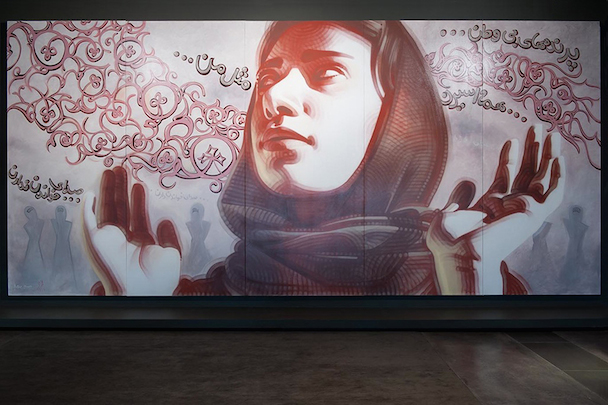
Born in Iran to Afghan parents, Shamsia Hassani is a street and digital artist working in the country’s complex and conflicted capital, where she returned in 2005 to pursue her education in Fine Art at Kabul University. A pioneer in Kabul’s contemporary art scene, she works to establish annual graffiti workshops across the country and, on a grander scale, to change the way society views women who refuse to conceal their opinions behind a veil of silence. Her work includes “Dreaming Graffiti,” a series in which the artist paints or Photoshops colours and images onto digital photographs to explore issues of national and personal security.

Shamsia sprays powerful, dreamy burqa-covered women on hidden walls, corners or alleyways in Kabul’s dusty streets. “Women in burqas are a symbol to change the minds of those that think that a covered woman can’t do anything.” Shamsia says, defiantly. “They are women, they can do anything. They are like normal people! I paint women with stronger shapes, movement and life to show them as being part of society.”

“Usually I am painting women with burqas in modernism shape on walls, I want to talk about their life, to find some way to remove them from darkness, to open their mind, to bring some positive changes, trying to remove all bad memories of war from everybody’s mind with covering sad city’s walls with happy colors.”
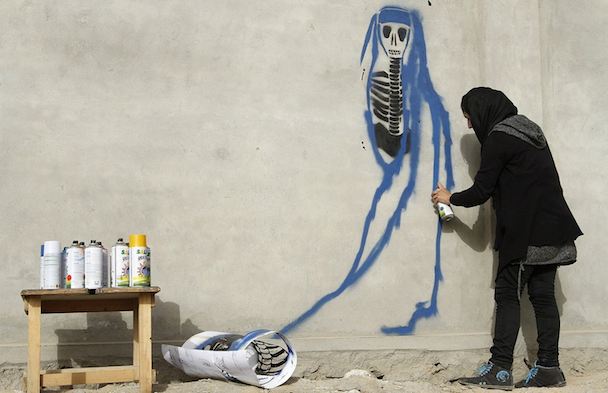
“Afghan graffiti contains lots of deep messages that often aren’t present in the West,” she explains. “For my artwork I’m not looking for any special technique. I only have one style and I don’t care if it’s good or bad quality. I’m not inspired by anyone.”